... or uses for your Christmas bucks!
I haven't posted since October 1st ... but I have been knitting up a storm (primarily for Christmas gifts, but also for another knitting book that should be out this Summer/early Fall). I've also been reading lots of the new knitting books that have exploded on the market lately. Here are some ideas for your reading and knitting pleasure:
1. Knitting history -- do you love it as much as I? I love reading about knitting, especially if the book can lay flat and I can knit while I read. If you've already got the classics: Richard Rutt's A History of Hand Knitting, Anne McDonald's No Idle Hands: A Social History of Knitting, and Susan Strawn's Knitting America: A Glorious Heritage from Warm Socks to High Art than your shelves REALLY need Nicky Epstein's latest opus, Knitting on Top of the World: The Global Guide to Traditions, Techniques and Design. This book is destined to be a classic in the knitting history panoply. Epstein's designs are a bit outre for me, but the information and the suggestions and just the shear inspiration of this work make it worth the money! The pictures and coffee-table styling of the book make it a great read-while-you-knit kind of book.
2. Technique books -- I'm sure you own all the classic stitch dictionaries like the Barbara Walker A Treasury of Knitting Patterns (vol. 1 thru 4), the Vogue stitchionaries (vol 1-3, vol 4 is [shudder] crochet!), or the Harmony Guide books from Interweave Press. Melissa Leapman has managed to go WAY beyond any of these with her latest two books, both on cable knitting: Cables Untangled: An Exploration of Cable Knitting and Continuous Cables: An Exploration of Knitted Cabled Knots, Rings, Swirls, and Curlicues. The first does a great job of dissecting cables and proving once and for all that cables are NOT hard to execute. The projects within the book cover the variety of hand-knit items where cabling looks great. The second book explains how to make design your own cable panels and pieces by explaining how to make cables grow from nothing (by hiding increases and decreases within your knititng) and how to design cables that imitate fancy celtic knots, braids and even nautical rope! Again, the projects are a great variety, using the techniques described earlier. But both of these books go beyond just being simple pattern books ... and this is why I'm highly recommending them for Christmas gifts (or Christmas money spending) ... the last one-third (if not more) of each of these books contain a cable dictionary -- smallest bits of cable pieces that can be joined together to create your own cable patterns. I predict that Melissa Leapman, based on these two books, will soon join the ranks of Barbara Walker and Vogue Knitters as classic authors for knitting designers.
Merry Christmas -- and let me know if you get any knitting books for Christmas that can compete with these.

Showing posts with label history. Show all posts
Showing posts with label history. Show all posts
Sunday, December 21, 2008


Sunday, March 04, 2007
I'm a nut ...
... a nut for history of knitting type books and a nut for ethnic knitting books. Books like Sheila McGregor's Traditional Fair Isle Knitting and Traditional Scandinavian Knitting, Nancy Bush's Folk Knitting in Estonia, Marcia Lewandowski's Andean Folk Knits, as well as the Folk Knit series from Interweave that includes: Folk Shawls, Folk Socks, Folk Vests, and Folk Mittens are all well-thumbed books on my design shelf. I get lots of inspiration and great ideas from these as well as feeding my fascination with knitting old and new. I love reading these books, over and over again; each time I read them I get new ideas or learn an ancient technique that I never knew ... and my knitting is better because of these kind of books.
 I just found out that a new book is coming in April -- I've actually pre-ordered it -- written by a fellow Association of Knitwear Designers member. Terri Shea has been working on a certification for museum studies and began her research on the Selbu knitting tradition in Norway. Her new book, Selbuvotter: Biography of a Knitting Tradition, contains the history of this unique cottage industry (that began with one young shepherdess tending her flock) and contains 30(!) patterns for mittens and gloves using the traditional designs of the Selbu. If you click on the link above, you can see sample pages of this fascinating work.
Go ahead (you know you want to) and pre-order this book -- should be here sometime around Easter so you can always say the Easter Bunny brought it!
Monday, May 29, 2006
Memorial Day memories of war knitting
Happy Memorial Day!
Don't forget how much knitting became a usual, everyday pasttime because of the need to outfit soldiers on foreign soil. Here are some articles about military knitting: Military Spouses Soldier On from New Jersey and Knitters Do Their Thing for Soldiers from Ohio. These are great examples of how knitting can really make a difference.
There's a great chunk in the knitting history book, No Idle Hands: The Social History of American Knitting by Anne Macdonald which details some of the many patterns and uses the hand-knits were used for when the homefront worked to support the various wars. The Red Cross still has patterns available to knit for the soldiers.
What are you doing this Memorial Day to honor those who fight for us?
Don't forget how much knitting became a usual, everyday pasttime because of the need to outfit soldiers on foreign soil. Here are some articles about military knitting: Military Spouses Soldier On from New Jersey and Knitters Do Their Thing for Soldiers from Ohio. These are great examples of how knitting can really make a difference.
There's a great chunk in the knitting history book, No Idle Hands: The Social History of American Knitting by Anne Macdonald which details some of the many patterns and uses the hand-knits were used for when the homefront worked to support the various wars. The Red Cross still has patterns available to knit for the soldiers.
What are you doing this Memorial Day to honor those who fight for us?
Thursday, May 11, 2006
A Fun Knitting Book
I've seen For the Love of Knitting: A Celebration of the Knitter's Art in catalogs and in the bookstore. It looked like one of those books non-knitters give their knitter friends. The kind of book that has taken the bookshelves by storm -- written by non-knitters to capitalize on the recent interest in knitting.
While at the library the other day, after having found "only two books each" for my littles I decided to wander over to the knitting shelves (746-ish in the Dewey Decimal system) and see if there was anything of interest.
And that was two days ago and I've been snatching minutes to read this wonderful book. The articles are by real knitters for real knitters. One article that particularly struck home was by knitter Lela Nargi about excitedly adding to your stash of yarn at a yarn sale and then having to hide it (and eventually get rid of it) because it wasn't as glorious as you thought. Believe me, real knitters do this all the time!
This book is chock full of wonderful articles and short stories that strike at the heart of all knitters. But, more than that. This book is great for those of us who love all things about knitting -- the history, goofy patterns, posters that show knitting. All things knitting!
Check it out at your Library today!
While at the library the other day, after having found "only two books each" for my littles I decided to wander over to the knitting shelves (746-ish in the Dewey Decimal system) and see if there was anything of interest.
And that was two days ago and I've been snatching minutes to read this wonderful book. The articles are by real knitters for real knitters. One article that particularly struck home was by knitter Lela Nargi about excitedly adding to your stash of yarn at a yarn sale and then having to hide it (and eventually get rid of it) because it wasn't as glorious as you thought. Believe me, real knitters do this all the time!
This book is chock full of wonderful articles and short stories that strike at the heart of all knitters. But, more than that. This book is great for those of us who love all things about knitting -- the history, goofy patterns, posters that show knitting. All things knitting!
Check it out at your Library today!
Monday, May 08, 2006
More Knitting in Art!
 This one is by an artist named Emile Munier (1840-1895) from the mid 1800's.
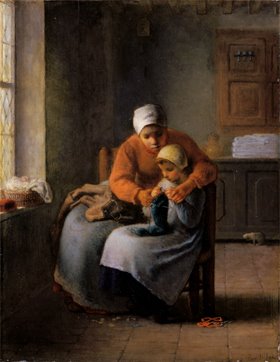 Jean-Francois Millet (1814-1875) painted this famous picture titled "The Knitting Lesson" about 1854.
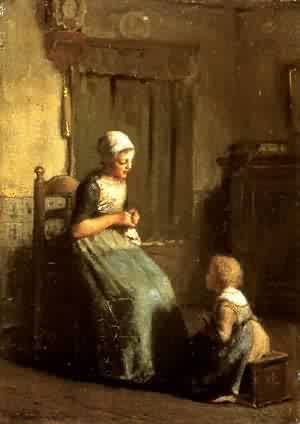 Here's one by Albert Neuhuijs, a Dutch painter(1844-1914). For english sites about his work, check for Albert Neuhuys.
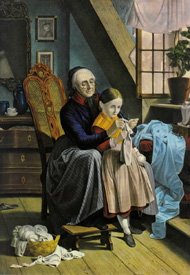
This is a print from Currier and Ives.
Wednesday, February 08, 2006
Knitting in Great Art
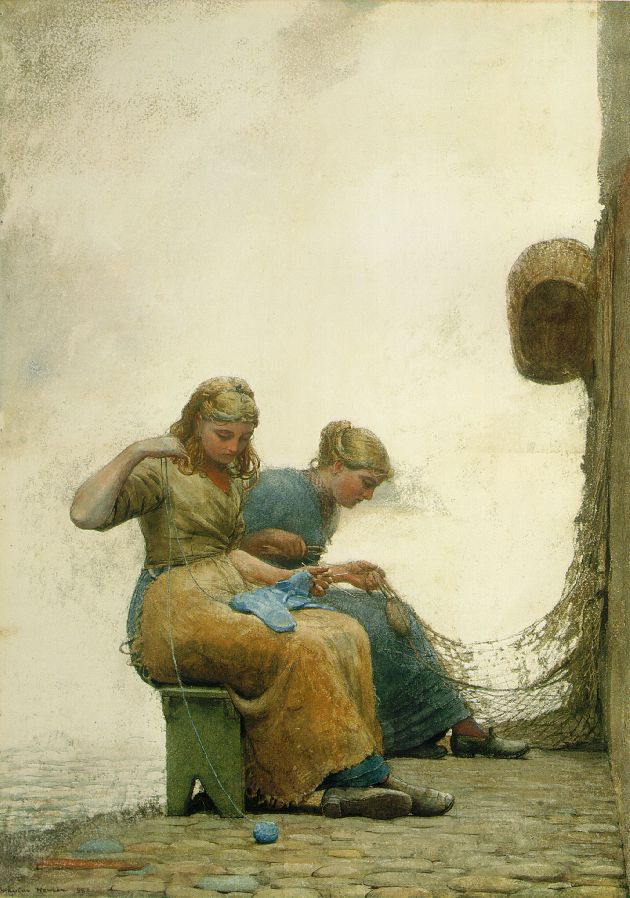
Winslow Homer's "Mending the Nets"
(or "Far From Billingsgate") -- 1882, England

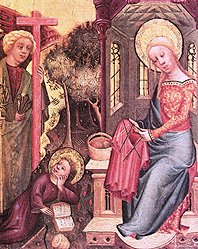
The Madonna Knitting Christ's Seamless Garment
 by Meister Bertram von Minden
(1345-1415), part of an altar triptych. Currently in the Hamburg Kunsthalle Museum.
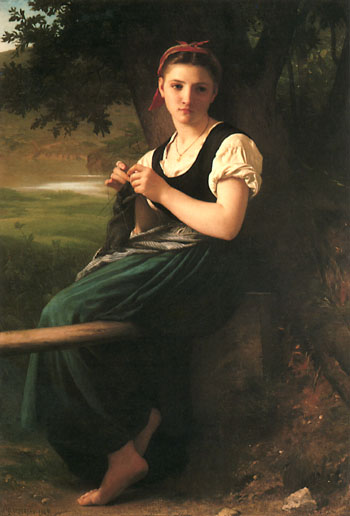
Adolphe William Bougereau painted The Knitting Girl in 1869
Wednesday, January 11, 2006
History of Knitting
(excerpted from www.wikipedia.com with additonal notes added)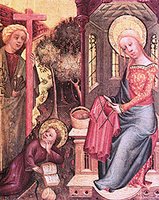
Early origins of knitting
An exact genographical origin for knitting cannot be specified. The craft is believed to have been developed B.C., but this is disputed today. The oldest remnants of seemingly knitted pieces are those that were worn as socks. It is believed that socks and stockings were the first pieces to be produced by techniques similar to knitting as they had to be shaped in order to fit the foot, whereas woven cloth could be used for most other items of clothing. Today it is known that these early socks were worked in Nålebinding, an ancient craft which involves creating fabric from thread by making multiple knots or loops. It is done with a needle (originally of wood or bone).
The first references to true knitting in Europe were in the early 14th century, though the first knitted socks from Egypt might be slightly older. At these early times, the purl stitch was unknown; in order to produce plain knitting it was necessary to knit in the round and then cut it open. The first reference to purl stitch dates from the mid-16th century, but the knowledge may have slightly preceded that.
Knitting Madonnas
During the 14th century, pictures of the Madonna and Child Jesus showed the Blessed mother knitting – usually knitting in the round with four or five needles. Legend explains that Mary knitted the “seamless garment” for Jesus that could not be torn by the soldiers during the Passion of Our Lord – basically, Mary made a seamless t-shirt for Jesus.
Knitting Madonnas can be seen in churches and museums throughout Western Europe and date from the early 1300s through to the end of the 1400s.
Importance of Church in Knitting
The Catholic Church, primarily in Spain, helped to spread the interest in knitting through the industry of ecclesiastical garments. Knitted liturgical gloves and altar garments are some of the surviving examples of this ancient knitting. Caps – including clerical caps – that fitted to the wearer’s head were also made extensively in the past.
Elizabethan period
During this era the manufacture of stockings was of vast importance to many Britons, who knitted with fine wool and exported their wares. Knitting schools were established as a way of providing an income to the poor, and the stockings that were made sent to Holland, Spain, and Germany.
The fashion of the period for men to wear short trunks made the fitted stockings commonly used, a fashion necessity.
Queen Elizabeth the First herself favoured silk stockings, these were finer, softer and much more expensive. Actual examples of stockings that belonged to her still remain, showing the high quality and decorative nature of the items specifically knitted for her.
Guild Knittings – MEN ONLY!
In the 16th and 17th centuries, when guilds were at their height, men served an apprencticeship for six years in order to be considered “master knitters”. According to knititng historian Mary Thomas, “three years to learn, three years to travel, after which the apprentice made his Masterpieces in thriteen weeks:
1. knit a carpet … the design to contain flowers, foliage, birds and animals in natural colors (approx. size 6 ft. x 5 ft).
2. knit a beret
3. knit a woolen shirt
4. knit a pair of hose with Spanish clocks
Importance in Scottish history
Knitting was such a vast occupation among those living on the Scottish Isles during the 17th and 18th centuries that the whole family would be involved in making sweaters, socks, stockings, etc. Fair Isle techniques were used to create elaborate colorful patterns. The sweaters were essential to the fishermen of these Isles, as the natural oils within the wool would provide some element of protection against the harsh weathers while out fishing.
Many elaborate designs were developed, such as cable stitch used on aran sweaters in Ireland.
Industrial revolution
Rudimentary knitting devices had been invented prior to this period, but were one-off creations. With the advent of the Industrial Revolution wool spinning, and cloth manufacture began to be done in factories. More women would be employed at operating machinery, rather than producing their home spun and knitted items.
The consistency of the factory spun wool was better in that it was more uniform, and the weight could be gauged better as a consequence.
Knitting for Victory: 1939-1945 (and don't forget the Civil War, WWl, Desert Storm, and the War in Iraq)
Make do and mend was the title of a booklet produced by the British wartime government department, the Ministry of Information.
Wool was in very short supply, as were so many things. The booklet encouraged women to unpick any old, unwearable, woollen items in order to re-use the wool.
Knitting patterns were issued for people to make items for the Army and Navy to wear in winter, such as balaclavas and gloves. This had the effect of producing the required items, but also gave a positive sense of achievement towards the war effort, by being able to contribute in this way.
1950s and 60s high fashion
After the war years, knitting has a huge boost as greater colours and styles of yarn were introduced. Many thousands of patterns fed a hungry market for fashionable designs in bright colours.
The "twinset" was an extremely popular combination for the home knitter. It consisted of a short-sleeved top with a cardigan in the same colour, to be worn together.
Girls were taught to knit in schools, as it was thought to be a useful skill, not just a hobby. Magazines such as "Pins and needles" in the UK, carried patterns of varying difficulty, with not just clothes, but items such as blankets, toys, bags, lace curtains and items that could be sold for profit.
1980s decline
The popularity of knitting showed a sharp decline in this period in the Western world. Sales of patterns and yarns slumped, as the craft was increasingly seen as old-fashioned and children were rarely taught to knit in school.
The increased availability and low cost of machine knitted items meant that consumers could have a beautiful looking sweater at the same cost of purchasing the wool and pattern themselves.
Revival in the New Millenium
Following this decline of knitting, manufacturers and designers looked for new ways to stimulate interest and creativity within the craft.
Focus was given to making specialty yarns, which could produce beautiful and stunning results.
Companies like Vogue worked to make their patterns the height of fashion, and Rowan Yarns popularised their patterns with high-quality magazines that bore no resemblance to the old-fashioned style once produced in bulk.
Celebrities including Julia Roberts, Winona Ryder and Cameron Diaz have been seen knitting and have helped to popularise the revival of the craft. A new phrase Guerilla Knitting has been coined for the practice of taking every opportunity to knit in public - often with a degree of organisation such as a mass tube knit-in.
Even men are knitting again as seen by the emergence of male knitting groups.
Bibliography
Macdonald, Anne L., No Idle Hands: The Social History of American Knitting, 1988
Rutt, Richard, A History of Hand Knitting, 1987 (reprinted 2000)
Thomas, Mary, Mary Thomas’s Knitting Book, 1938 (reprinted by Dover Publications, 1972)
Early origins of knitting
An exact genographical origin for knitting cannot be specified. The craft is believed to have been developed B.C., but this is disputed today. The oldest remnants of seemingly knitted pieces are those that were worn as socks. It is believed that socks and stockings were the first pieces to be produced by techniques similar to knitting as they had to be shaped in order to fit the foot, whereas woven cloth could be used for most other items of clothing. Today it is known that these early socks were worked in Nålebinding, an ancient craft which involves creating fabric from thread by making multiple knots or loops. It is done with a needle (originally of wood or bone).
The first references to true knitting in Europe were in the early 14th century, though the first knitted socks from Egypt might be slightly older. At these early times, the purl stitch was unknown; in order to produce plain knitting it was necessary to knit in the round and then cut it open. The first reference to purl stitch dates from the mid-16th century, but the knowledge may have slightly preceded that.
Knitting Madonnas
During the 14th century, pictures of the Madonna and Child Jesus showed the Blessed mother knitting – usually knitting in the round with four or five needles. Legend explains that Mary knitted the “seamless garment” for Jesus that could not be torn by the soldiers during the Passion of Our Lord – basically, Mary made a seamless t-shirt for Jesus.
Knitting Madonnas can be seen in churches and museums throughout Western Europe and date from the early 1300s through to the end of the 1400s.
Importance of Church in Knitting
The Catholic Church, primarily in Spain, helped to spread the interest in knitting through the industry of ecclesiastical garments. Knitted liturgical gloves and altar garments are some of the surviving examples of this ancient knitting. Caps – including clerical caps – that fitted to the wearer’s head were also made extensively in the past.
Elizabethan period
During this era the manufacture of stockings was of vast importance to many Britons, who knitted with fine wool and exported their wares. Knitting schools were established as a way of providing an income to the poor, and the stockings that were made sent to Holland, Spain, and Germany.
The fashion of the period for men to wear short trunks made the fitted stockings commonly used, a fashion necessity.
Queen Elizabeth the First herself favoured silk stockings, these were finer, softer and much more expensive. Actual examples of stockings that belonged to her still remain, showing the high quality and decorative nature of the items specifically knitted for her.
Guild Knittings – MEN ONLY!
In the 16th and 17th centuries, when guilds were at their height, men served an apprencticeship for six years in order to be considered “master knitters”. According to knititng historian Mary Thomas, “three years to learn, three years to travel, after which the apprentice made his Masterpieces in thriteen weeks:
1. knit a carpet … the design to contain flowers, foliage, birds and animals in natural colors (approx. size 6 ft. x 5 ft).
2. knit a beret
3. knit a woolen shirt
4. knit a pair of hose with Spanish clocks
Importance in Scottish history
Knitting was such a vast occupation among those living on the Scottish Isles during the 17th and 18th centuries that the whole family would be involved in making sweaters, socks, stockings, etc. Fair Isle techniques were used to create elaborate colorful patterns. The sweaters were essential to the fishermen of these Isles, as the natural oils within the wool would provide some element of protection against the harsh weathers while out fishing.
Many elaborate designs were developed, such as cable stitch used on aran sweaters in Ireland.
Industrial revolution
Rudimentary knitting devices had been invented prior to this period, but were one-off creations. With the advent of the Industrial Revolution wool spinning, and cloth manufacture began to be done in factories. More women would be employed at operating machinery, rather than producing their home spun and knitted items.
The consistency of the factory spun wool was better in that it was more uniform, and the weight could be gauged better as a consequence.
Knitting for Victory: 1939-1945 (and don't forget the Civil War, WWl, Desert Storm, and the War in Iraq)
Make do and mend was the title of a booklet produced by the British wartime government department, the Ministry of Information.
Wool was in very short supply, as were so many things. The booklet encouraged women to unpick any old, unwearable, woollen items in order to re-use the wool.
Knitting patterns were issued for people to make items for the Army and Navy to wear in winter, such as balaclavas and gloves. This had the effect of producing the required items, but also gave a positive sense of achievement towards the war effort, by being able to contribute in this way.
1950s and 60s high fashion
After the war years, knitting has a huge boost as greater colours and styles of yarn were introduced. Many thousands of patterns fed a hungry market for fashionable designs in bright colours.
The "twinset" was an extremely popular combination for the home knitter. It consisted of a short-sleeved top with a cardigan in the same colour, to be worn together.
Girls were taught to knit in schools, as it was thought to be a useful skill, not just a hobby. Magazines such as "Pins and needles" in the UK, carried patterns of varying difficulty, with not just clothes, but items such as blankets, toys, bags, lace curtains and items that could be sold for profit.
1980s decline
The popularity of knitting showed a sharp decline in this period in the Western world. Sales of patterns and yarns slumped, as the craft was increasingly seen as old-fashioned and children were rarely taught to knit in school.
The increased availability and low cost of machine knitted items meant that consumers could have a beautiful looking sweater at the same cost of purchasing the wool and pattern themselves.
Revival in the New Millenium
Following this decline of knitting, manufacturers and designers looked for new ways to stimulate interest and creativity within the craft.
Focus was given to making specialty yarns, which could produce beautiful and stunning results.
Companies like Vogue worked to make their patterns the height of fashion, and Rowan Yarns popularised their patterns with high-quality magazines that bore no resemblance to the old-fashioned style once produced in bulk.
Celebrities including Julia Roberts, Winona Ryder and Cameron Diaz have been seen knitting and have helped to popularise the revival of the craft. A new phrase Guerilla Knitting has been coined for the practice of taking every opportunity to knit in public - often with a degree of organisation such as a mass tube knit-in.
Even men are knitting again as seen by the emergence of male knitting groups.
Bibliography
Macdonald, Anne L., No Idle Hands: The Social History of American Knitting, 1988
Rutt, Richard, A History of Hand Knitting, 1987 (reprinted 2000)
Thomas, Mary, Mary Thomas’s Knitting Book, 1938 (reprinted by Dover Publications, 1972)
Subscribe to:
Posts (Atom)