 Don't you just LOVE this picture of the Blessed Mother knitting Jesus' seamless garment (that he'll later wear on Calvary) while He looks on, reading a book and the Angel is standing there with the tools of the Crucifixion! Pretty amazing art from the early 1400's by Meister Bertram (13__-1425)
Showing posts with label Catholic. Show all posts
Showing posts with label Catholic. Show all posts
Thursday, February 01, 2007
Mary in art
Don't you just LOVE this picture of the Blessed Mother knitting Jesus' seamless garment (that he'll later wear on Calvary) while He looks on, reading a book and the Angel is standing there with the tools of the Crucifixion! Pretty amazing art from the early 1400's by Meister Bertram (13__-1425)

Beautiful Writing on Knitting
Louise at 4real posted about Rita Munn's latest column. Mrs. Munn is a Catholic homeschooling mom who writes a monthly newsletter to users of Catholic Heritage Curriculum resources. This month's column is an absolutely glorious essay on knitting and hand crafts and family and homeschooling and God. Please take a minute to read these wonderful thoughts from this wonderful woman!
Sunday, December 03, 2006
Going Offline for the Season
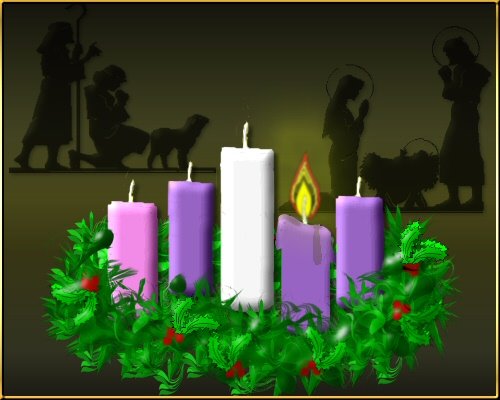 Today is the first Sunday of Advent 2006. This means that in four short weeks, Christmas will be here -- the Incarnation, the Word made Flesh. As a special present to my family, I am going to go off-line for the season and spend the time working with and for my family -- finishing knitted gifts, teaching the kids about the true spirit of Christmas and just generally playing with my family.
I will be back posting in 2007.
I wish you all a very Holy and Blessed Advent and Christmas; you are all in my thoughts and prayers as we prepare our home for the coming of Jesus!
Wednesday, April 12, 2006
Knitted Last Supper
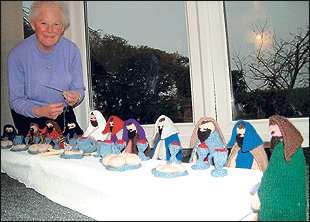 Check out this link to an article about a very crative knitter from Devon, UK who has knit the Last Supper and looks to be done just in time for Holy Thursday!
Here's the article.
Meaning Behind my Logo

So, I bet you've been wondering about my logo. I'm sure you can tell that this is the Blessed Virgin Mary, knitting with Jesus on her knee. Isn't it cool? With a name like "Mary", how could I have any other patroness than the Blessed Mother herself?
Here's the story behind it all. This is the original clip-art I found when browsing the web.
 It's from a block print that was housed in the Tate (but has since been sold). This block print was done by artist Eric Gill (1882-1940) , a British printmaker. The Latin around the outside , roughly translates to: All Praise the God Who Creates.
Once I saw it, I knew it would make a great logo with some tweaking. So I got my brother, who is an awesome "freelance illustrator" named Paul Nowak, to create a logo based on this print.
I like Paul's version as the Blessed Mother has almost a 1920s look to her. I love the idea that Mary is knitting with Jesus on her knee, holding him while knitting his seamless garment which would show up again during His Passion and Death.
The name of my knitting work, "By Hand, With Heart ... hand-knit designs", comes from the idea that everything I create -- whether for personal use or commercial use -- is always created from my heart. I love yarns and knitting and seeing the creation that God has given me the talent to make. All of my work is done by hand and I am the only knitter. I've always got something on the needles -- sometimes more than one project at a time.
I hope you enjoy perusing my knitting musings as well as pictures of some of my favorite projects and links to my favorite resources.
HAPPY KNITTIN' and DESIGNIN'
Wednesday, February 01, 2006
Founderess of Madonna House on Artists and Craftpeople
God's Troubadours of Beauty: Artists and Handicrafters By Catherine Doherty
Arts and crafts made by one's own hands, reflecting the ingenuity and creation of one's own mind, can bring beauty into the world and make God's presence more visible. For all creative effort is from God, and God is Beauty itself. Both crafts and the fine arts, such as painting and sculpture, can be a bond of tradition, bridging the old and the new. Unless there are such bridges, people are fragmented, each like an island unto himself or herself. We are unmoored and do not know where we came from or where we are going. Because of the rapid pace of our technological age, an artistic bridge with our roots is more needed than ever.
As a bridge of communication, especially with those who speak different languages or who may be fearful, shy, or sick, crafts often bring special blessings. There is something reassuring, homey, pleasant, and relaxing in seeing someone embroidering or knitting on a train. One feels a trust and confidence about such a person. If one has some similar work at hand, one becomes friends almost without words. Or one might ask what the other is making and a bond of friendship, gentle and warm, is established with this person who only a short time ago was a stranger. The craft is the bridge.
Handicrafters can "gather up the fragments lest they be wasted," as Jesus says in the Gospel (John 6:12). Rather than turn up their noses at what might appear to be "junk," they can fashion something beautiful of it, or restore what would otherwise have been wasted. They are able to use materials that other people might reject; one man's scrap is another man's gold. Handicrafters help others to recognize the hidden potential for beauty in scraps. But handicrafts are much more. Humanly and psychologically, creating is one of our needs as persons.
What today are called crafts, yesterday were simply all the things people needed to make in order to live: clothes, housing, tools and domestic utensils. So crafts were not just a pastime to keep occupied but rather one's creativeness at work, finding ways to fill real needs. As people became more skillful they crafted more beautifully the things they needed. Artists who are humble and are people of prayer realize that God is going to create through them. They bring a new dimension to human lives: they bring enthusiasm for art, for beauty, and creativity to everyone they meet. God has sent them as teachers of a new "language" to their brothers and sisters and neighbors. They liberate spirits and give peace. To create is to be at peace, for in creating one is joined with the Creator. Yet this peace will permit, in fact will almost demand its opposite: tension. Tension is part of creation, part of life. These tensions, and artists' fears and doubts, must be endured and then transmitted into art.
Artists are ordinary people with extraordinary gifts; they know they cannot bear the weight of these gifts so they lay them in the hands of God. They know they have to lean on God; they know that God is the great Artist. They are like a bridge between God and man. The artist is a mirror who reflects God's image in his creation. Art need not have a religious subject, for all beauty reminds people that God is the creator. Artists are his troubadours of beauty. An artist is a healer who partakes of the power of the Good Physician because his or her works console and comfort. However, his or her art must also ask questions, for the artist is a "disturber" of people as well, like Christ is; artists do not allow people to fall into a sort of mediocrity.
Artists must live in the truth: in truth with God, with themselves, and with the world because it is to the world that they have to convey the truth. Art defies all definitions of efficiency in production. Artists need to be given time for their work. It may appear as if they "do nothing," but their doing nothing is essential to their creativity: having time to think, time to wander through the woods and through the cities to observe and to sketch, time to research, time to talk, and time to pray. An artist needs understanding and encouragement. We must be reverent before the gift of creativity in whatever its form. Artists are Gospel people, to whom talents have been given. They put those talents to work so that when the Master comes, he finds them doubled, quadrupled, or maybe even returned to Him a hundredfold. In sharing their talents, they are like just stewards, who give out grain to all their household. Artists are pilgrims in search of beauty, in search of ways and means to bring God to all humanity.
From The Vision on the Mountain: The Madonna House Artist and The People of the Towel and the Water, by Catherine Doherty
Arts and crafts made by one's own hands, reflecting the ingenuity and creation of one's own mind, can bring beauty into the world and make God's presence more visible. For all creative effort is from God, and God is Beauty itself. Both crafts and the fine arts, such as painting and sculpture, can be a bond of tradition, bridging the old and the new. Unless there are such bridges, people are fragmented, each like an island unto himself or herself. We are unmoored and do not know where we came from or where we are going. Because of the rapid pace of our technological age, an artistic bridge with our roots is more needed than ever.
As a bridge of communication, especially with those who speak different languages or who may be fearful, shy, or sick, crafts often bring special blessings. There is something reassuring, homey, pleasant, and relaxing in seeing someone embroidering or knitting on a train. One feels a trust and confidence about such a person. If one has some similar work at hand, one becomes friends almost without words. Or one might ask what the other is making and a bond of friendship, gentle and warm, is established with this person who only a short time ago was a stranger. The craft is the bridge.
Handicrafters can "gather up the fragments lest they be wasted," as Jesus says in the Gospel (John 6:12). Rather than turn up their noses at what might appear to be "junk," they can fashion something beautiful of it, or restore what would otherwise have been wasted. They are able to use materials that other people might reject; one man's scrap is another man's gold. Handicrafters help others to recognize the hidden potential for beauty in scraps. But handicrafts are much more. Humanly and psychologically, creating is one of our needs as persons.
What today are called crafts, yesterday were simply all the things people needed to make in order to live: clothes, housing, tools and domestic utensils. So crafts were not just a pastime to keep occupied but rather one's creativeness at work, finding ways to fill real needs. As people became more skillful they crafted more beautifully the things they needed. Artists who are humble and are people of prayer realize that God is going to create through them. They bring a new dimension to human lives: they bring enthusiasm for art, for beauty, and creativity to everyone they meet. God has sent them as teachers of a new "language" to their brothers and sisters and neighbors. They liberate spirits and give peace. To create is to be at peace, for in creating one is joined with the Creator. Yet this peace will permit, in fact will almost demand its opposite: tension. Tension is part of creation, part of life. These tensions, and artists' fears and doubts, must be endured and then transmitted into art.
Artists are ordinary people with extraordinary gifts; they know they cannot bear the weight of these gifts so they lay them in the hands of God. They know they have to lean on God; they know that God is the great Artist. They are like a bridge between God and man. The artist is a mirror who reflects God's image in his creation. Art need not have a religious subject, for all beauty reminds people that God is the creator. Artists are his troubadours of beauty. An artist is a healer who partakes of the power of the Good Physician because his or her works console and comfort. However, his or her art must also ask questions, for the artist is a "disturber" of people as well, like Christ is; artists do not allow people to fall into a sort of mediocrity.
Artists must live in the truth: in truth with God, with themselves, and with the world because it is to the world that they have to convey the truth. Art defies all definitions of efficiency in production. Artists need to be given time for their work. It may appear as if they "do nothing," but their doing nothing is essential to their creativity: having time to think, time to wander through the woods and through the cities to observe and to sketch, time to research, time to talk, and time to pray. An artist needs understanding and encouragement. We must be reverent before the gift of creativity in whatever its form. Artists are Gospel people, to whom talents have been given. They put those talents to work so that when the Master comes, he finds them doubled, quadrupled, or maybe even returned to Him a hundredfold. In sharing their talents, they are like just stewards, who give out grain to all their household. Artists are pilgrims in search of beauty, in search of ways and means to bring God to all humanity.
From The Vision on the Mountain: The Madonna House Artist and The People of the Towel and the Water, by Catherine Doherty
Subscribe to:
Posts (Atom)