Sophia Sloane offered to teach her (new teacher, Anne) a perfectly elegant new pattern of knit lace, so nice for trimming an apron.

Monday, March 06, 2006
Lucy Maud Montgomery and Knitting
From Anne of Green Gables (pg 133-134)


Friday, March 03, 2006
"A Symphony for the Sheep"
In Mary Azarian's absolutely beautifully illustrated A Symphony for the Sheep (written by C.M. Millen), a special place is given to knitters. About the middle of the book (and thus, the middle of the "song"), Mrs. Millen writes:
Now knitting is better
because you are able
to knit while you natter
and chat while you cable.
While weavers are loners
and spinners keep quiet
two knitters together
can make quite a riot
and several can gather
together and blather
while outfitting sweaters
that outwit the weather.
Which might be the reason
that in every season
as rain fills the sky
Irish wit remains dry!
Knitters chat and knit
chat and knit
chat and knit and natter.
Knitters chat and slip
chat and knit
chat and purl.
Living Knitting in the Laura Ignalls Wilder's Books
Here are some great examples of living knitting from Laura Ingalls Wilder's first book, Little House in the Big Woods
pg 74: "In each stocking there was a pair of bright red mittens..."
pg 78: "Pa and Uncle Peter had each a pair of new, warm mittens, knit in little squares of red and white. Ma and Aunt Eliza had made them."
pg 139: "Then they pulled on their beautiful white stockings, that they had knit of fine cotton thread in lacy, openwork patterns, and they buttoned up their best shoes."
pg 140: "Then Aunt Ruby and Aunt Docia put on their flannel petticoats and their plain petticoats and their stiff, starched white petticoats with knitted lace all around the flounces."
pg 236: "Ma had blown out the lamp because she did not need its light. On the other side of the hearth she was swaying gently in her rocking chair and her kitting needles flashed in and out above the
sock she was knitting."
In Little House on the Prairie, Ma seems too busy to knit. However there is one scene that describes Ma's shawl:
pg 220-221.
"He wrapped Laura in Ma's big shawl, and then he hugged her. Everything was all right. The house was cozy with firelight, there was the warm, brown smell of coffee, Ma was smiling, and Pa was there.
The shawl was so large that Mary wrapped the other end of it around her. Pa pulled off his stiff boots and warmed his stiff, cold hands. Then he sat on the bench and he took Mary on one knee and Laura on the other and he hugged them against him, all snuggled in the shawl..."
In Farmer Boy, the odd book of the series that tells about Laura's future husband, Almanzo Wilder's childhood, the mother is always knititng in the evenings. Here's what she knits:
pg. 87 "Mother was dressed in brown merino, with a white lace collar, and white lace frills at her wrists, under the big bell-shaped sleeves. She had knitted the lace of finest thread, and it was like cobwebs."On the Banks of Plum Creek really shows the grit and determination of the Ingalls crowd.
pg. 286 "In the evenings Mother's knitting needles flashed and clicked, making new stockings for them all. She knitted so fast that the needles got hot from rubbing together."
pg. 316 "Then he pulled out a new pair of mittens. Mother had knit the wrists and backs in a fancy stitch."
pg. 318 "Mother had knitted new lace collars and black lace mitts for them (Alice and Eliza Jane) both."
pg. 88 Finally cozy in their dugout on the banks of Plum Creek. "Bits of firelight came through the seams of the stove and twinkled on Ma's steel knitting needles and tried to catch Pa's elbow."
pg. 189 "He stretched out his foot. HIs mended boot was cracked clear across the toes. They all looked at his red knitted sock showing through that gaping slit."
pg. 284 "They watched Pa and Ma starting gaily away. Ma was so pretty, in her brow-and-red Christmas shawl, with her brown knit hood tied under he chin ..."
pg. 294 "It was pleasant in the warm house. Laura and Mary did their lessons, then Pa played the fiddle while Ma rocked and knitted, and bean soup simmered on the stove."
pg. 300 "So Laura brought the bootjack and Pa pulled off his boots and drew another pair of socks over those he already wore. Ma gave him a new pair which she had just finished knitting of think, warm wool."
pg. 310 "A ball of fire was rolling down the stovepipe. It was bigger than Ma's big ball of yarn. It rolled across the stove and dropped to the floor as Ma sprang up. She snatched up her skirts and stamped on it. But it seemed to jump through her foot, and it rolled to the knitting she had dropped. Ma tried to brush it into the ashpan. It ran in front of her knitting needles, but it followed the needles back. Another ball of fire had rolled down the stovepipe, and another. They rolled across the floor after the knitting needles and did not burn the floor."
By the Shores of Silver Lake has a now-blind Mary, Laura becoming a real helper to Ma, Carrie now old enough to run and play with Laura, and a new baby, Grace.
pg. 159 "Listening to stories, Grace would fall asleep. Then Ma laid her in her trundle bed by the stove, and they all settled down for a cosy afternoon of knitting and sewing and crocheting."
pg. 164 "Laura and Carrie hurried into their coats and hoods and mittens. Their shoes were new and the soles thick. Ma had knit their stockings of woolen yarn, and their red flannel underclothes came down over their knees and buttoned in a snug band around each stocking."
pg. 175 "Mary had knitted new, warm socks for Pa's Christmas present."
pg. 176 "Laura and Mary had wanted to make mittens for Carrie, but they had not enough yarn...'I know!' Mary said. 'We'll make the hands white, and the wrists in red and blue stripes!"
pg. 192 "So was Mr. Boast. His present was wristlets, knitted in stripes of red and gray. They fitted him perfectly."
pg. 208 "On stormy days, Mrs. Boast brought her sewing or knitting, and those were cosy days of reading and talking."
In The Long Winter, Mary (although blind) is often shown knitting.
pg. 40 “Ma and Mary knitted busily, in quilt-covered rockers drawn close to the oven, and Laura stood wrapped in her shawl, between the stove and wall.”
pg. 50 “ ‘It must be one of Laura’s queer notions,’ Mary said, busily knitting in her chair by the stove.”
pg. 53 “Mary took up her knitting again and Laura went on sweeping.”
pg. 116 “In the sunshine from the western windows Mary rocked gently, and Laura’s steel knitting needles flashed. Laura was knitting lace, of fine white thread, to trim a petticoat.”
pg. 181 "Mary unwrapped the yards of fine knitted lace. She fingered it lovingly and her face was shining with delight."
Little Town on the Prairie finds Mary off to college at last and Laura in town and enjoying it.
pg. 91 "They had made four new petticoats for Mary, two of unbleached muslin, one of bleached muslin, and one of fine white cambric. Around the bottom of the fine cambric one, Laura had sewed with careful, tiny stitches the six yards of knitted lace that she had given Mary for Christmas."
pg. 96-97 "Ma must make Mary a winter hat of velvet, and knit some stockings for her, and Laura was knitting her a pair of mitts, of brown silk thread."
pg. 177 "Laura was crocheting a nubia of soft white wool, for Mary's Christmas present in college, and Mary Power was knitting a silk necktie for her father's Christmas."
pg. 233 "The Christmas box had gone to Mary. In it Ma carefully placed the nubia that Laura had crocheted of soft, fleecy wool, as white as the big snowflakes falling gently outside the windows. She put in the lace collar that she had knitted of finest white sewing thread."
pg. 244 "The room was as dainty as Mrs. Woodworth. They hesitated to lay their coats on the dainty bed, with its knitted white coverlet and ruffled pillow shams. Thin, ruffled white muslin curtains were draped back at the windows, and on a little stand-table a knitted lace doily lay under the lamp. White knitted lace to match was spread on the bureau top, and white lace was draped across the top of the mirror frame."
In These Happy Golden Years -- what starts out for Laura as a pretty miserable venture into adulthood turns into a lovely love story...and knitting is always present.
pg. 34 "The patchwork cushions were in them, and there was Ma's workbasket and her knitting with the needles thrust into the ball of yarn."
pg. 69 "She doubled her thick black woolen veil and wrapped it twice around her face and hood, and wound its long ends around her throat."
pg. 90 "Ma was gently rocking while she knitted by the sunny window..."
pg. 152 "At recess and during the long noon hour, she knitted lace while the children played."
pg. 159 "She (Ma) had hung white muslin curtains at the windows; they were edged with white knitted lace."
pg. 161 "She put on her knitted white-lace sotckings, and buttoned her high, well-polished black shoes."
pg. 266 "Laura brought out the dozens of yards of white thread lace that she had knitted and crocheted, and like magic the machine's flashing needle stitched the lace edgings to the open ends of the pillow cases, the throats and wrists of the high-neck, long-sleeved nightgowns, the necks and armholes of the chemises, and the leg-bands of the drawers."
pg. 274 "In the hatbox of the trunk's till, Laura put her new hat with the ostrich tips, and in the shallow till itself she set her knittting and crochet needles and worsted yarns."
Published posthumously, The First Four Years is about Laura and Manly's life in their first four years of marriage. It's filled with hardwork and love, as well as a glimpse at Laura's growing love of knitting.
pg. 22 "Afternoons, she always put on a clean dress and sat in the parlor corner of the front room sewing, or knitting on Manly's socks."
pg. 39 "Laura kept the fire going from the store of coal in the storm shed. She cooked from the stores in her pantry and cellar and she sang at her knitting in the afternoon."
pg. 85 "She was knitting him a whole long-sleeved undershirt of fine, soft, Shetland wool yarn for a Christmas surprise. It was difficult to keep it hidden from him and get it finished, but after Christmas she could knit its mate easily."
Monday, February 27, 2006
Knitting the Animals!
I just finished a commissioned baby blanket and stuffed toy. The parents of the pending Birthday Boy are heirs to a dairy farm. The nursery is cows so when their friend saw String Bean's "Sassy Cassie Cow" (which has had much stuffing removed during nap times!) and Bam-Bam's Lamb binky -- I had a sale!
Here's the end result:
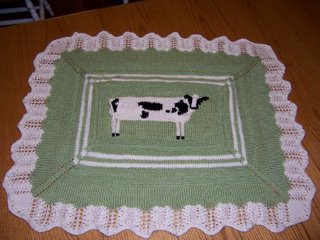
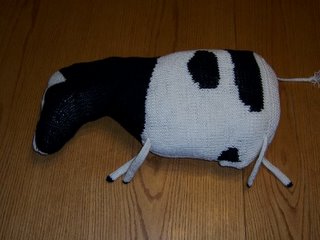
This commission came just as I had finished "Captain Cook" (see Mr. Popper's Penguins) for Bam-Bam!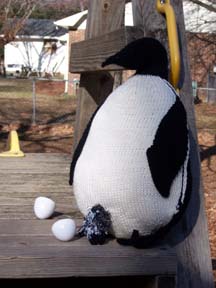
Here's the end result:
This commission came just as I had finished "Captain Cook" (see Mr. Popper's Penguins) for Bam-Bam!
Wednesday, February 08, 2006
Knitting in Great Art
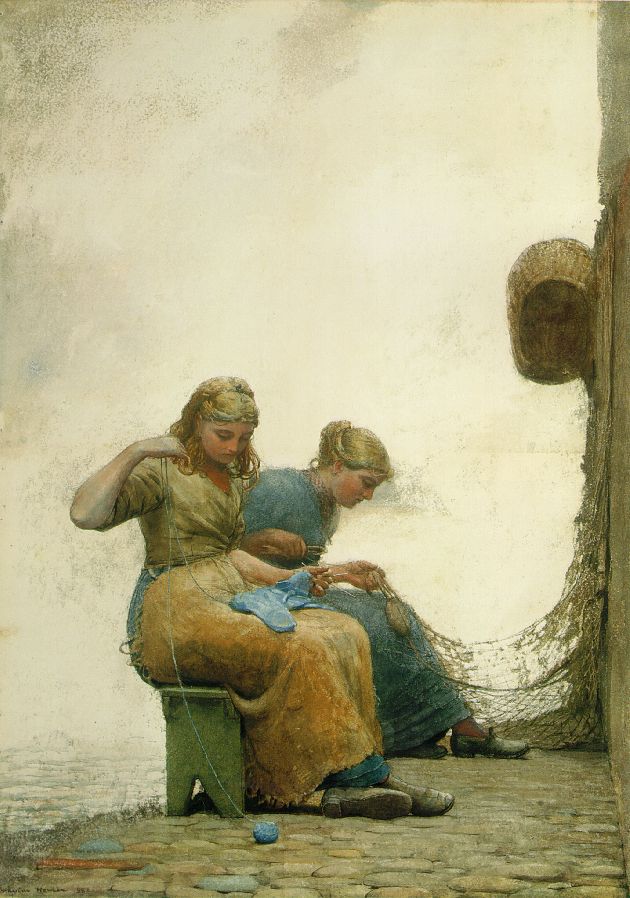
Winslow Homer's "Mending the Nets"
(or "Far From Billingsgate") -- 1882, England

The Madonna Knitting Christ's Seamless Garment
 by Meister Bertram von Minden
(1345-1415), part of an altar triptych. Currently in the Hamburg Kunsthalle Museum.
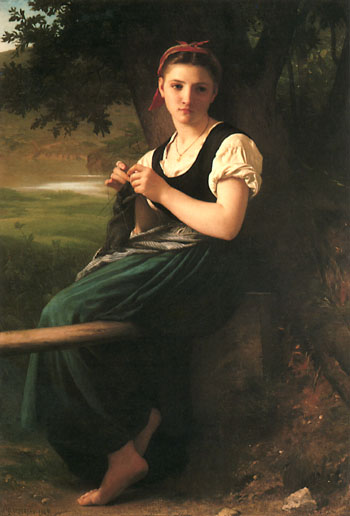
Adolphe William Bougereau painted The Knitting Girl in 1869
Wednesday, February 01, 2006
Founderess of Madonna House on Artists and Craftpeople
God's Troubadours of Beauty: Artists and Handicrafters By Catherine Doherty
Arts and crafts made by one's own hands, reflecting the ingenuity and creation of one's own mind, can bring beauty into the world and make God's presence more visible. For all creative effort is from God, and God is Beauty itself. Both crafts and the fine arts, such as painting and sculpture, can be a bond of tradition, bridging the old and the new. Unless there are such bridges, people are fragmented, each like an island unto himself or herself. We are unmoored and do not know where we came from or where we are going. Because of the rapid pace of our technological age, an artistic bridge with our roots is more needed than ever.
As a bridge of communication, especially with those who speak different languages or who may be fearful, shy, or sick, crafts often bring special blessings. There is something reassuring, homey, pleasant, and relaxing in seeing someone embroidering or knitting on a train. One feels a trust and confidence about such a person. If one has some similar work at hand, one becomes friends almost without words. Or one might ask what the other is making and a bond of friendship, gentle and warm, is established with this person who only a short time ago was a stranger. The craft is the bridge.
Handicrafters can "gather up the fragments lest they be wasted," as Jesus says in the Gospel (John 6:12). Rather than turn up their noses at what might appear to be "junk," they can fashion something beautiful of it, or restore what would otherwise have been wasted. They are able to use materials that other people might reject; one man's scrap is another man's gold. Handicrafters help others to recognize the hidden potential for beauty in scraps. But handicrafts are much more. Humanly and psychologically, creating is one of our needs as persons.
What today are called crafts, yesterday were simply all the things people needed to make in order to live: clothes, housing, tools and domestic utensils. So crafts were not just a pastime to keep occupied but rather one's creativeness at work, finding ways to fill real needs. As people became more skillful they crafted more beautifully the things they needed. Artists who are humble and are people of prayer realize that God is going to create through them. They bring a new dimension to human lives: they bring enthusiasm for art, for beauty, and creativity to everyone they meet. God has sent them as teachers of a new "language" to their brothers and sisters and neighbors. They liberate spirits and give peace. To create is to be at peace, for in creating one is joined with the Creator. Yet this peace will permit, in fact will almost demand its opposite: tension. Tension is part of creation, part of life. These tensions, and artists' fears and doubts, must be endured and then transmitted into art.
Artists are ordinary people with extraordinary gifts; they know they cannot bear the weight of these gifts so they lay them in the hands of God. They know they have to lean on God; they know that God is the great Artist. They are like a bridge between God and man. The artist is a mirror who reflects God's image in his creation. Art need not have a religious subject, for all beauty reminds people that God is the creator. Artists are his troubadours of beauty. An artist is a healer who partakes of the power of the Good Physician because his or her works console and comfort. However, his or her art must also ask questions, for the artist is a "disturber" of people as well, like Christ is; artists do not allow people to fall into a sort of mediocrity.
Artists must live in the truth: in truth with God, with themselves, and with the world because it is to the world that they have to convey the truth. Art defies all definitions of efficiency in production. Artists need to be given time for their work. It may appear as if they "do nothing," but their doing nothing is essential to their creativity: having time to think, time to wander through the woods and through the cities to observe and to sketch, time to research, time to talk, and time to pray. An artist needs understanding and encouragement. We must be reverent before the gift of creativity in whatever its form. Artists are Gospel people, to whom talents have been given. They put those talents to work so that when the Master comes, he finds them doubled, quadrupled, or maybe even returned to Him a hundredfold. In sharing their talents, they are like just stewards, who give out grain to all their household. Artists are pilgrims in search of beauty, in search of ways and means to bring God to all humanity.
From The Vision on the Mountain: The Madonna House Artist and The People of the Towel and the Water, by Catherine Doherty
Saturday, January 14, 2006
Here's a priceless definition of living knitting
My almost 6 yo String Bean and I were driving to pick up Kotch.
From the back seat: "Mom, do you know how to make a boy like you?"
Mom, driving on a busy interstate: "Well, um, honey -- what do you mean?"
From the back seat: "You just knit something every year for Christmas for him. Pretty soon you'll be married."
Mom, grinning from ear-to-ear: "Oh. Well,now, do you stop knitting for him once you're married?"
From the back seat: "Oh, no! Once you're married, you can knit for him whenever you want. For his birthday, or whatever."
Well, there you go!
Subscribe to:
Posts (Atom)